Beautiful Japandi Kitchen Design: How to Get the Calm, Timeless Look
If your kitchen is the busiest room in the house, a Japandi kitchen is the calm you’re looking for. It’s Japanese calm meeting Scandinavian warmth: clean lines, natural wood, soft neutral colors, and nothing on the counter that doesn’t earn its spot.
I’m Toki, and I’m writing this from a 77-year-old house with my husband and three kids, so every idea here has to work in a real, busy kitchen. I’ll walk you through Japandi kitchen design from layout to lighting, plus a few everyday upgrades.
You can start tonight with one free change: clear your counters down to three things.
Some of the links are affiliate links, so I may receive a small commission if you purchase through them (at no cost to you)! As an Amazon Associate I earn from qualifying purchases.
Key Takeaways
If you only have a minute, here’s the short version:
- A Japandi kitchen blends Japanese minimalism with Scandinavian warmth, so it feels calm without feeling cold.
- Stick to two or three materials, usually light wood, stone, and ceramic, and repeat them around the room.
- Warm neutrals like creamy white, sand, and soft greige (a warm gray-beige) work better than stark white or cool gray.
- Flat-panel Japandi kitchen cabinets with slim handles or finger grooves keep the lines quiet and the counters clear.
- Layered lighting does more for the mood than any single fixture, so plan it early.
- Save on small things like a faucet or pulls, and spend where it counts: cabinets, counters, and one good light fixture.
Short on time? Clear your counters tonight, then jump to the weekend plan whenever you’re ready.
What Is a Japandi Kitchen? A Simple Definition
A Japandi kitchen is a simple, warm, working kitchen that borrows calm from Japan and coziness from Scandinavia.
The word “Japandi” is just Japanese plus Scandinavian. In a kitchen, that means quiet shapes, natural materials, and storage that hides the clutter so you can actually enjoy cooking.
Where Japandi Comes From
Scandinavian designers have admired Japanese craftsmanship since the late 1800s, so these two styles were friends long before anyone gave them a nickname. Both care about function, quality materials, and a close connection to nature.
Japanese vs. Scandinavian vs. Japandi

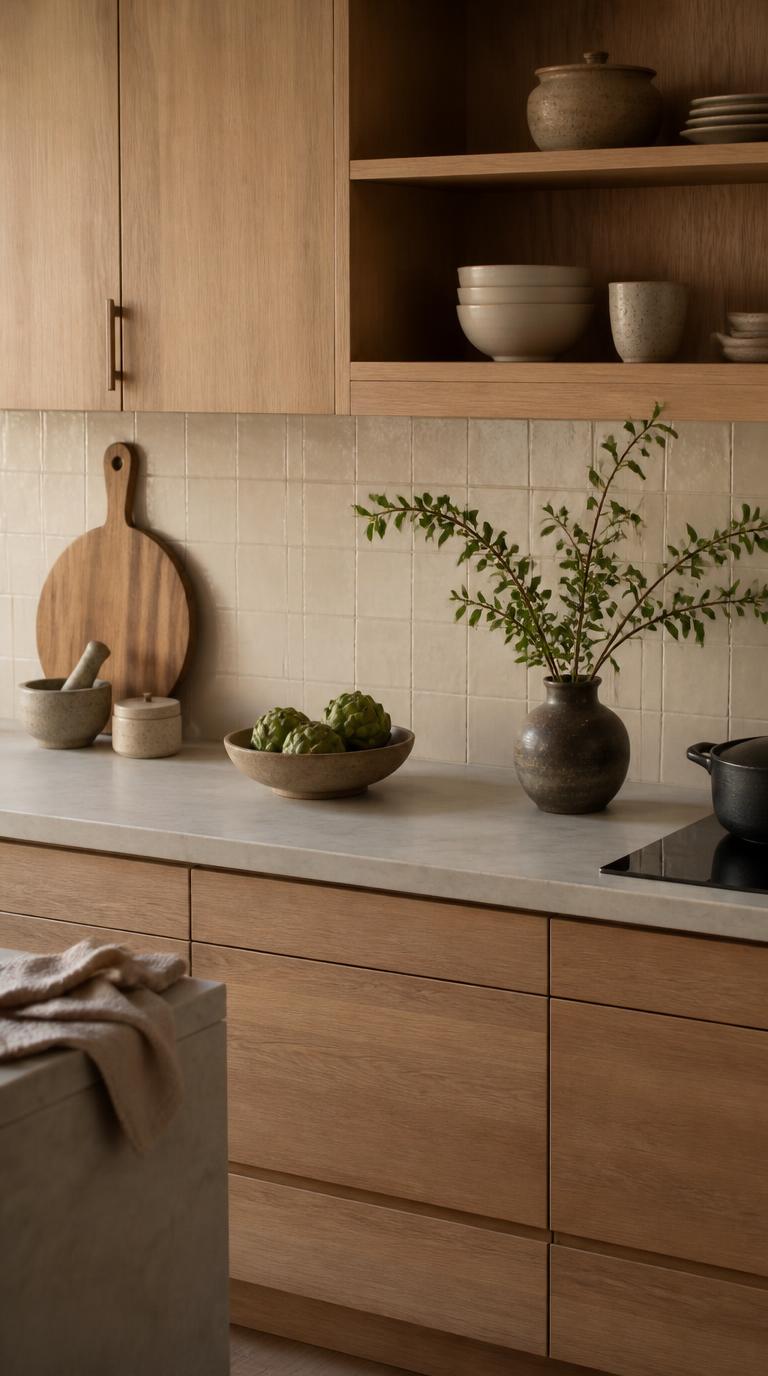
Here’s how the three looks compare, so you can see what a Japandi style kitchen keeps from each side.
| Element | Japanese | Scandinavian | Japandi kitchen |
|---|---|---|---|
| Wood tone | Pale hinoki (a light, golden Japanese cypress) and darker stained woods | Mostly light and pale | Warm light wood with one darker accent |
| Colors | Natural neutrals, charcoal, deep indigo accents | Soft whites and pastels | Warm neutrals plus one deep tone |
| Mood | Serene and spare | Cozy, hygge-style (that snug, candlelit Danish feeling) | Calm and cozy together |
| Decor | Very few pieces | Layered textiles | A few handmade pieces and one soft textile |
Why Warm Neutral Works in a Kitchen
Warm neutrals keep a kitchen bright in the morning and gentle at night. Cool gray can feel cold once the sun goes down, while creamy whites and sand tones stay soft.
You’ll also see wabi-sabi here, the Japanese idea of finding beauty in imperfect, handmade things. A slightly uneven ceramic bowl fits right in.
Japandi Kitchen Design Principles: Less, but Better

Three habits do most of the work in Japandi kitchen design: edit, repeat, and make every piece earn its spot.
Edit Before You Add
Start by clearing the counters. Keep out only what you use daily or almost daily, like a kettle or coffee maker, a cutting board, and maybe one plant. With three kids in the house, I’d stop there. Everything else gets a home inside a cabinet or drawer.
Repeat Materials, Not Patterns
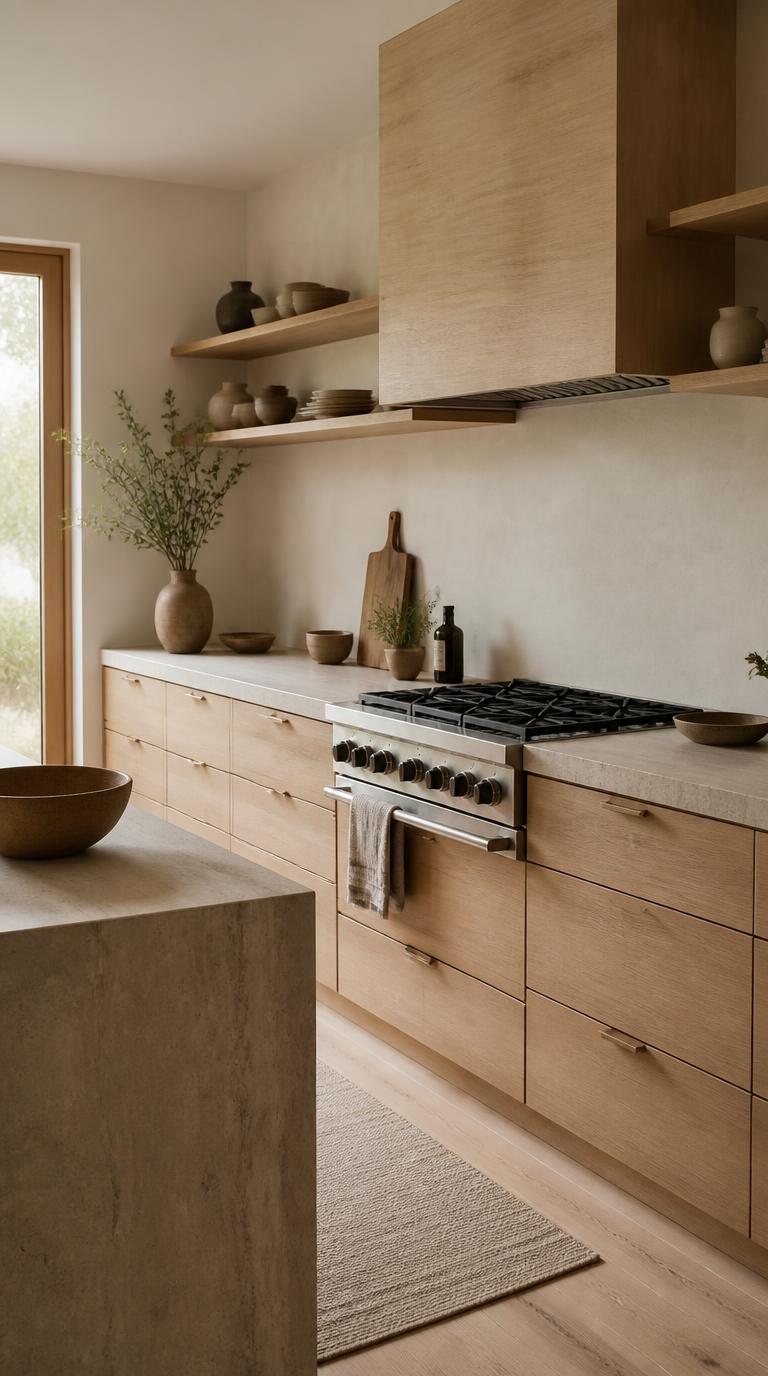
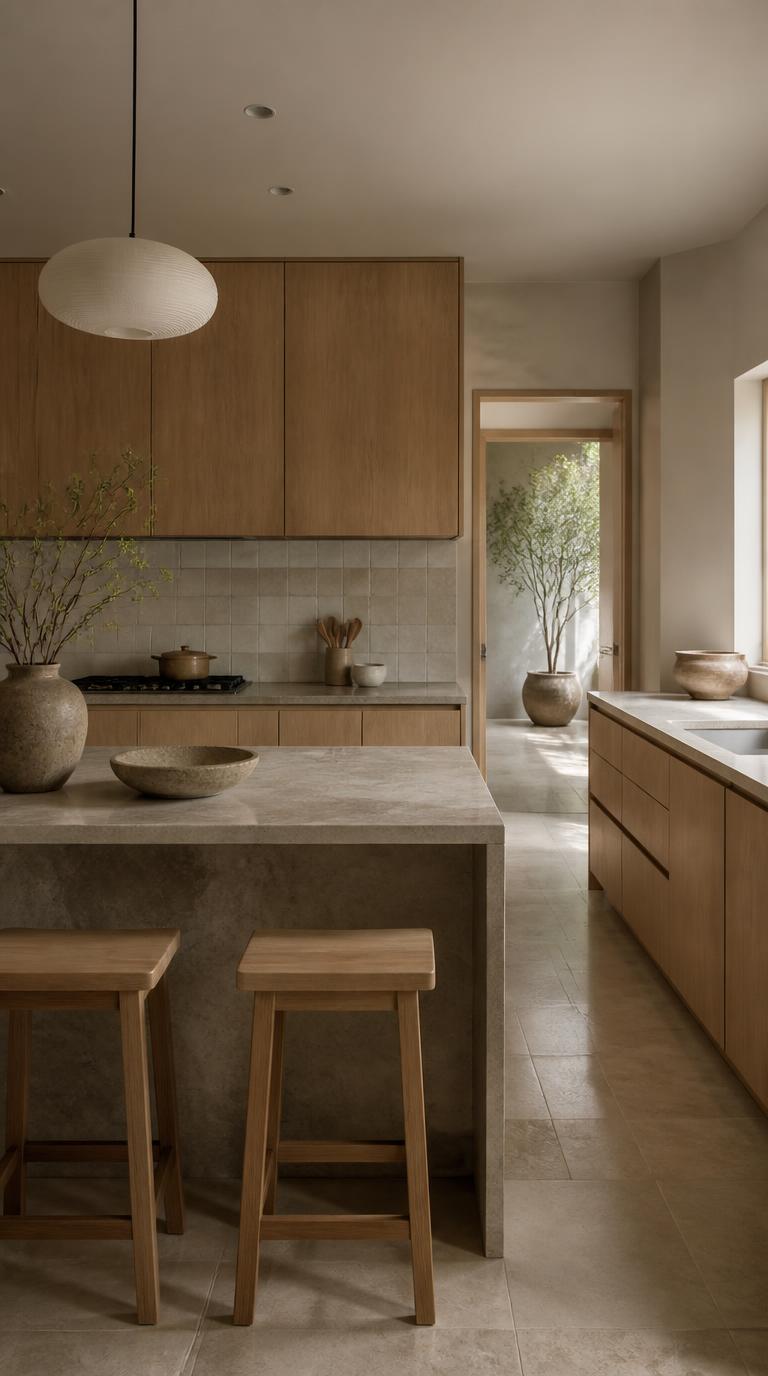
Pick two or three materials and repeat them around the room. Light oak, honed (matte, not shiny) stone, and ceramic are a classic trio. Busy patterns fight the calm, so let texture do the talking instead.
Make Every Piece Earn Its Spot
A modern Japandi kitchen isn’t empty. It’s intentional. Before anything stays on display, run it through this quick test:
- Do I use it at least once a week?
- Does it match my materials and colors?
- Does it have a home when I’m done with it?
If the answer is no, it goes in a drawer or out the door. Empty isn’t the goal. Calm is.
Japandi Kitchen Layout That Actually Works
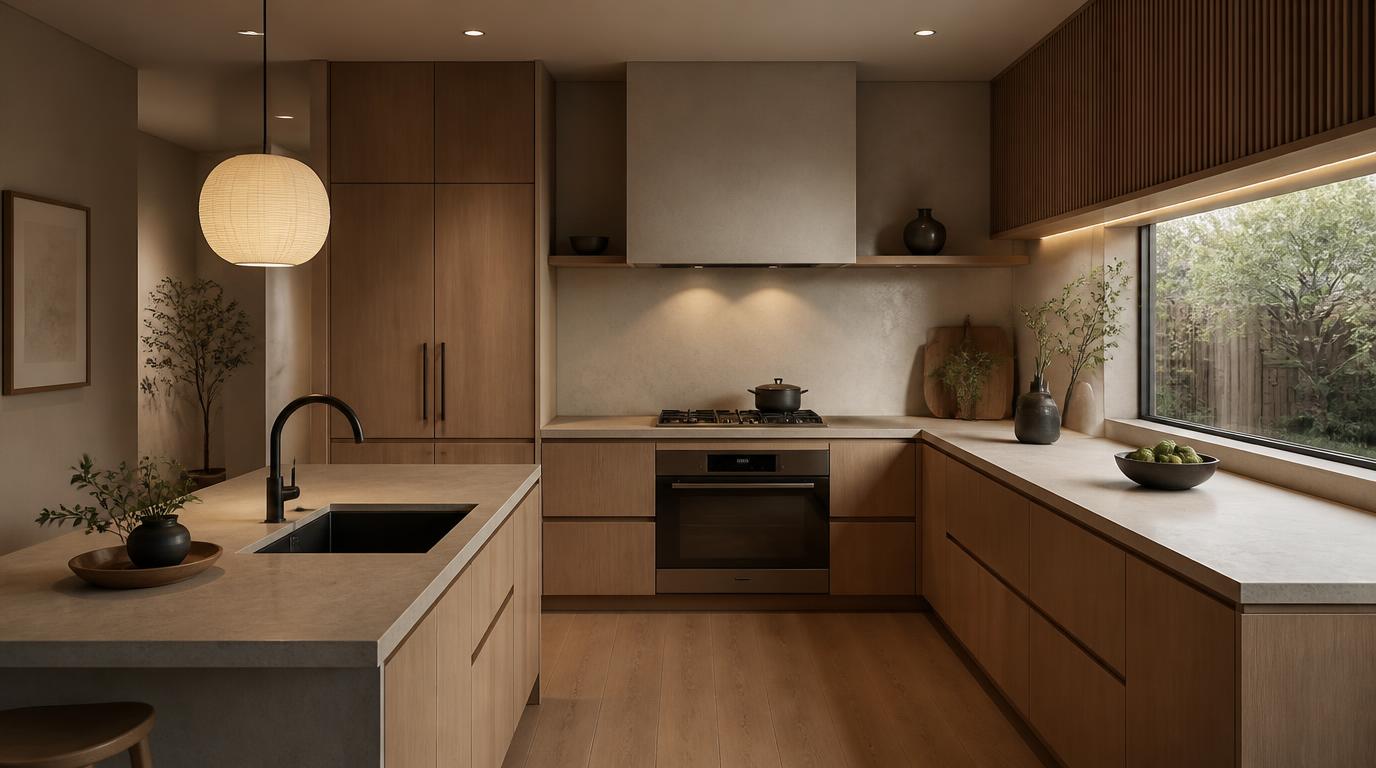
A calm kitchen is an easy-to-walk kitchen: short distances between sink, stove, and fridge, and aisles wide enough to move through.
The Work Triangle in Plain English
Your sink, stove, and fridge form a triangle, and you walk it all day.
If you like to measure, the National Kitchen & Bath Association’s planning guidelines suggest each side of that triangle measure between 4 and 9 feet, with all three sides adding up to no more than 26 feet.
Here’s an easy check: walk from the sink to the stove, then the fridge, then back. If it feels like a short loop rather than a hike, you’re in good shape.
Zones Beat Gadgets
Group things by what you do, not by what they are. Keep knives, boards, and oils near your prep space. Keep mugs and tea near the kettle. Fewer steps means fewer things left out on the counter.
Give Yourself Room to Move
Tight aisles make any kitchen feel busy, even a beautiful one. The aisle is the walking space between your counters and the island, and these are the clearances I’d aim for:
| Who’s cooking | Minimum aisle width between counters (or counters and island) |
|---|---|
| One cook in the kitchen | At least 42 inches |
| Two cooks working together | At least 48 inches |
That extra space also makes room for little helpers, which matters if your kitchen doubles as a snack station.
One more thing for older homes like mine: measure everything twice. Walls and cabinets in an older house are rarely perfectly square, so standard sizes may need a little adjusting.
Built before 1978? Test old paint for lead before you sand or scrape. Use an EPA-recognized test kit and follow its directions to test every layer, or hire a certified pro. If it tests positive, don’t sand it yourself.
Japandi Kitchen Cabinets, Countertops, and Materials
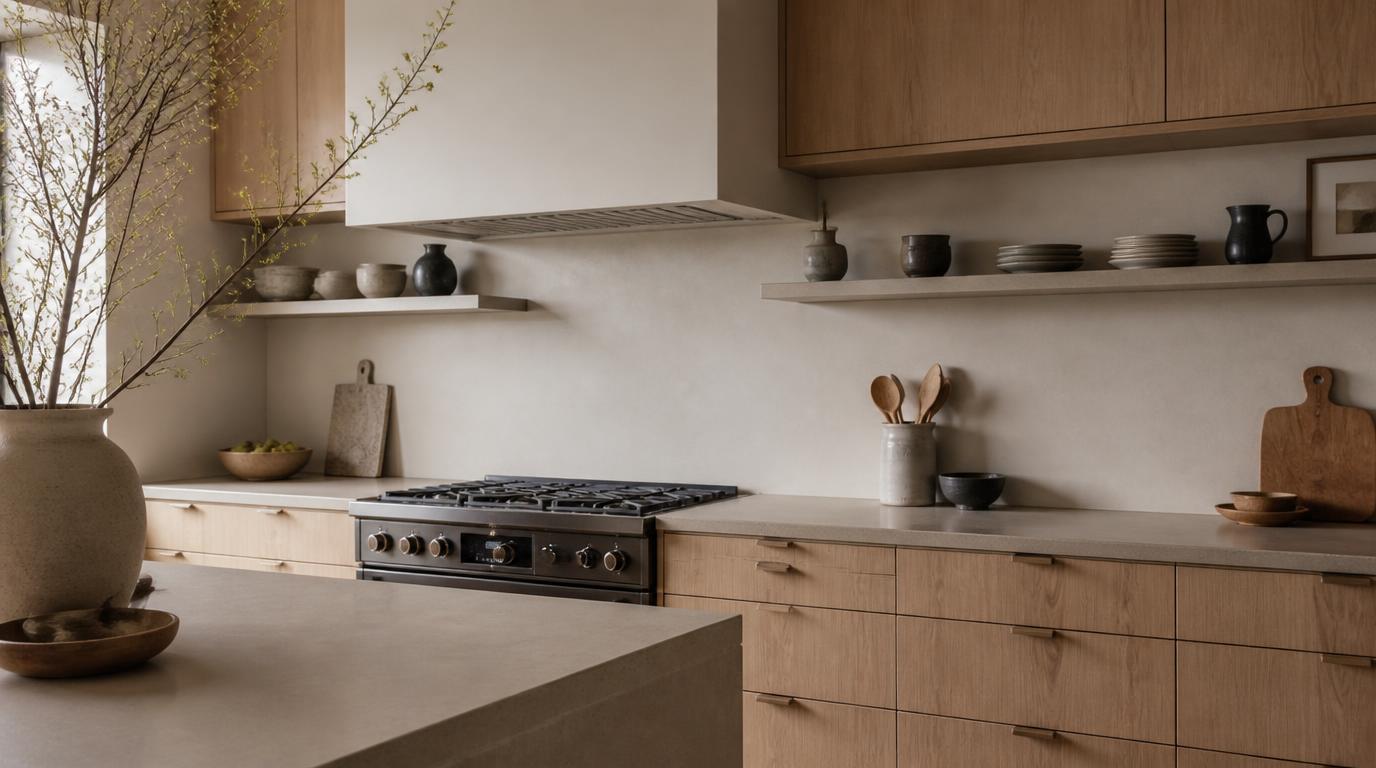
The right materials make a Japandi kitchen feel warm: light wood, honed (matte, not shiny) stone, and a little handmade ceramic.
Japandi Kitchen Cabinets

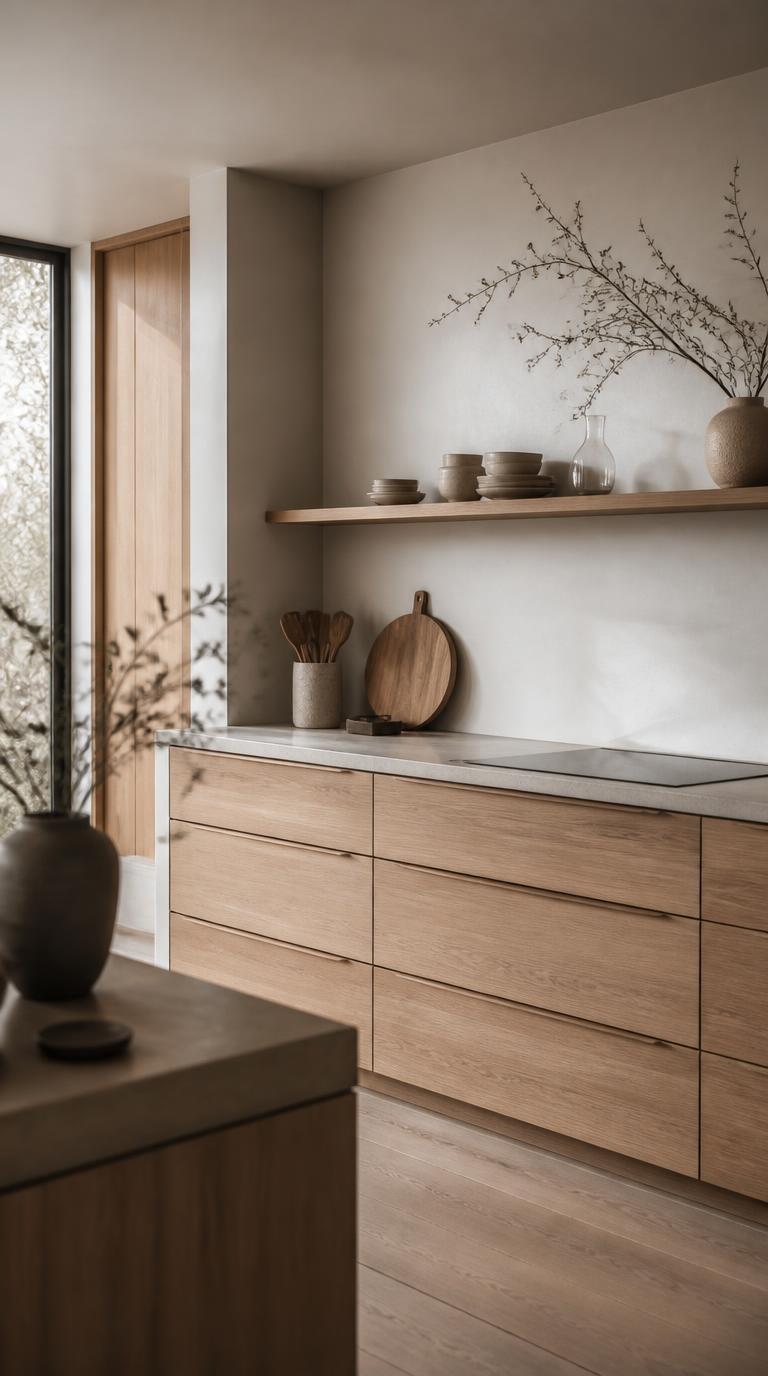
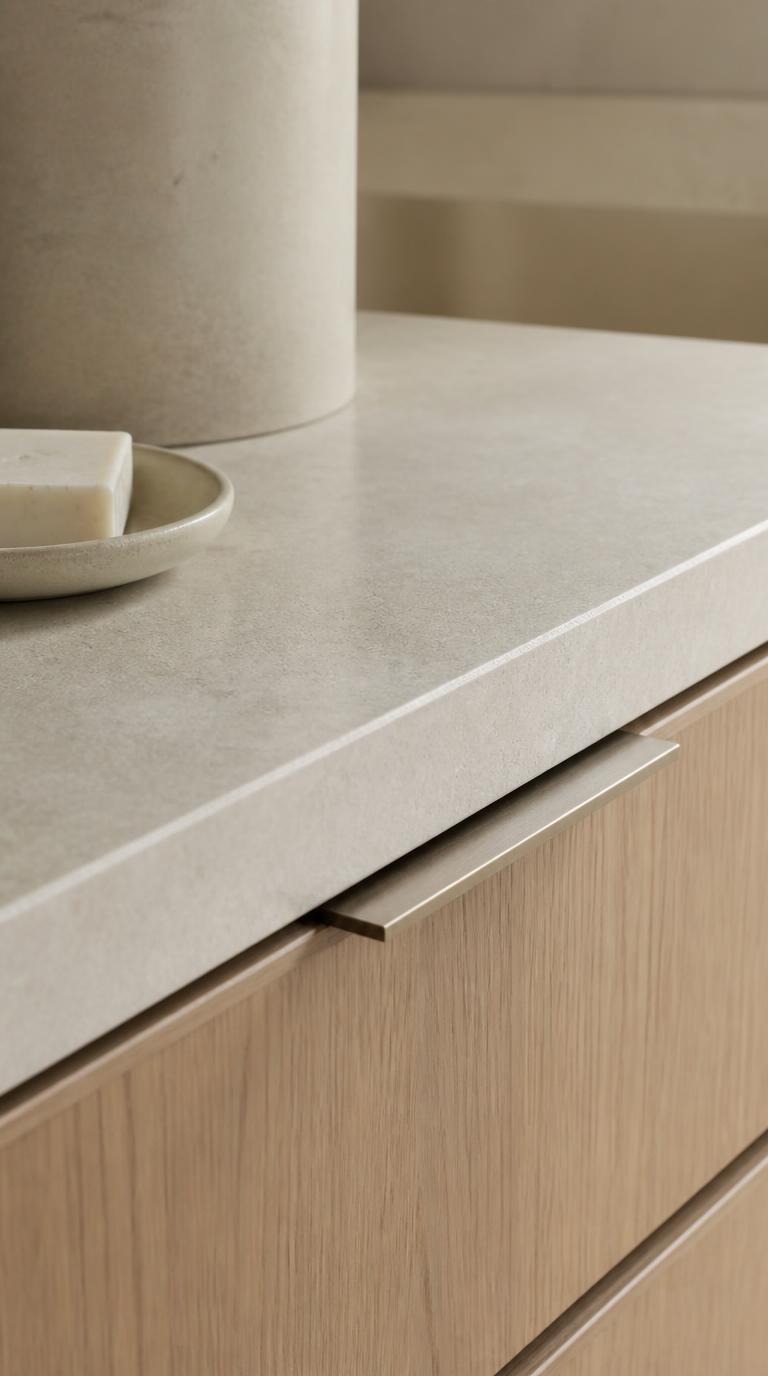
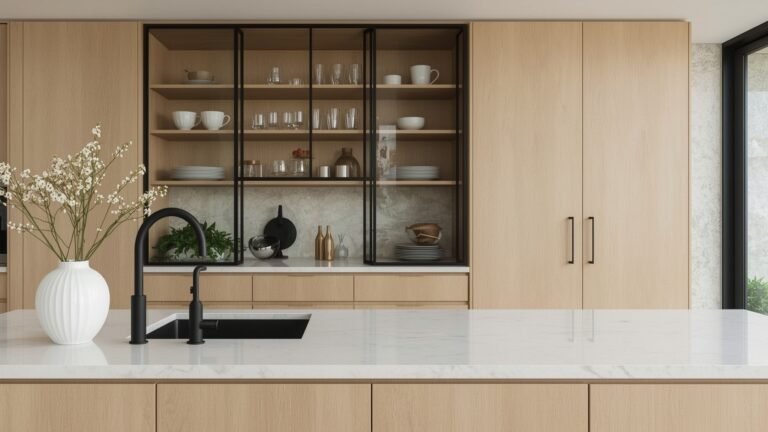
Japandi kitchen cabinets have flat-panel doors with no fussy trim. Go for light oak, ash, or maple.
Or paint them a warm white in a cabinet-grade enamel (a tough paint made for doors and trim) with a satin or low-sheen finish. True flat paint scuffs and is harder to wipe clean.
Then add slim pulls (handles), or skip them altogether with finger grooves (small cut-outs you grip with your fingertips).
If you have little hands around, a low-sheen finish shows fewer fingerprints than a glossy one.
Countertops and Backsplash


Choose a stone or quartz in cream or a warm greige-gray with that same matte finish. Ask for honed or matte, since polished is more common in quartz.
Honed marble and other soft stones can stain and dull more easily, so quartz is the lower-maintenance pick with kids around. Quartz isn’t heat-proof, though, so keep a trivet handy for hot pans.
For the backsplash, simple rectangular or square tiles keep things quiet, while hexagons and circles tend to feel busier to many people.
Love the look of butcher block? Condition it with food-safe mineral oil: a coat a day for the first week, then about once a month or whenever it looks dry.
Wipe up spills quickly, because oil keeps the wood happy but isn’t a waterproof seal.
How to Mix Wood Tones Without Overthinking It
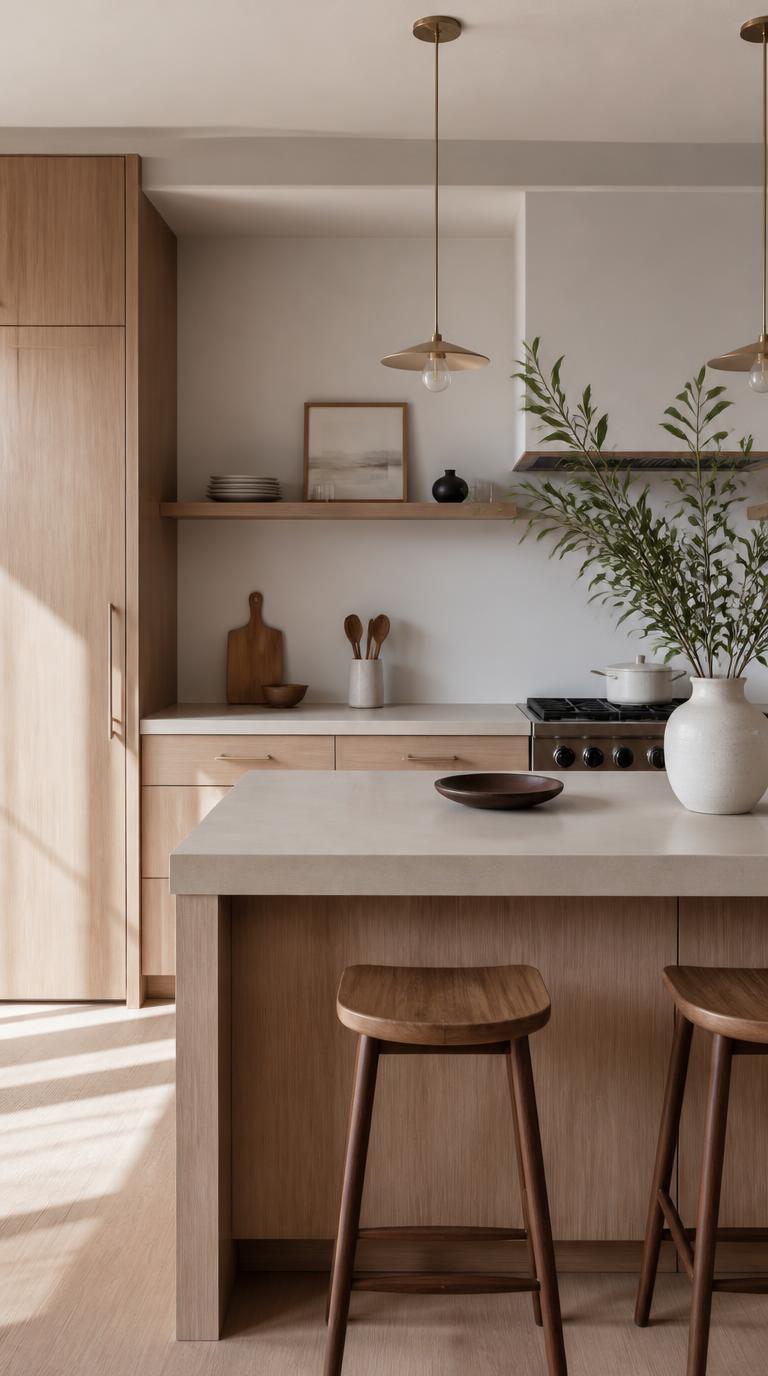
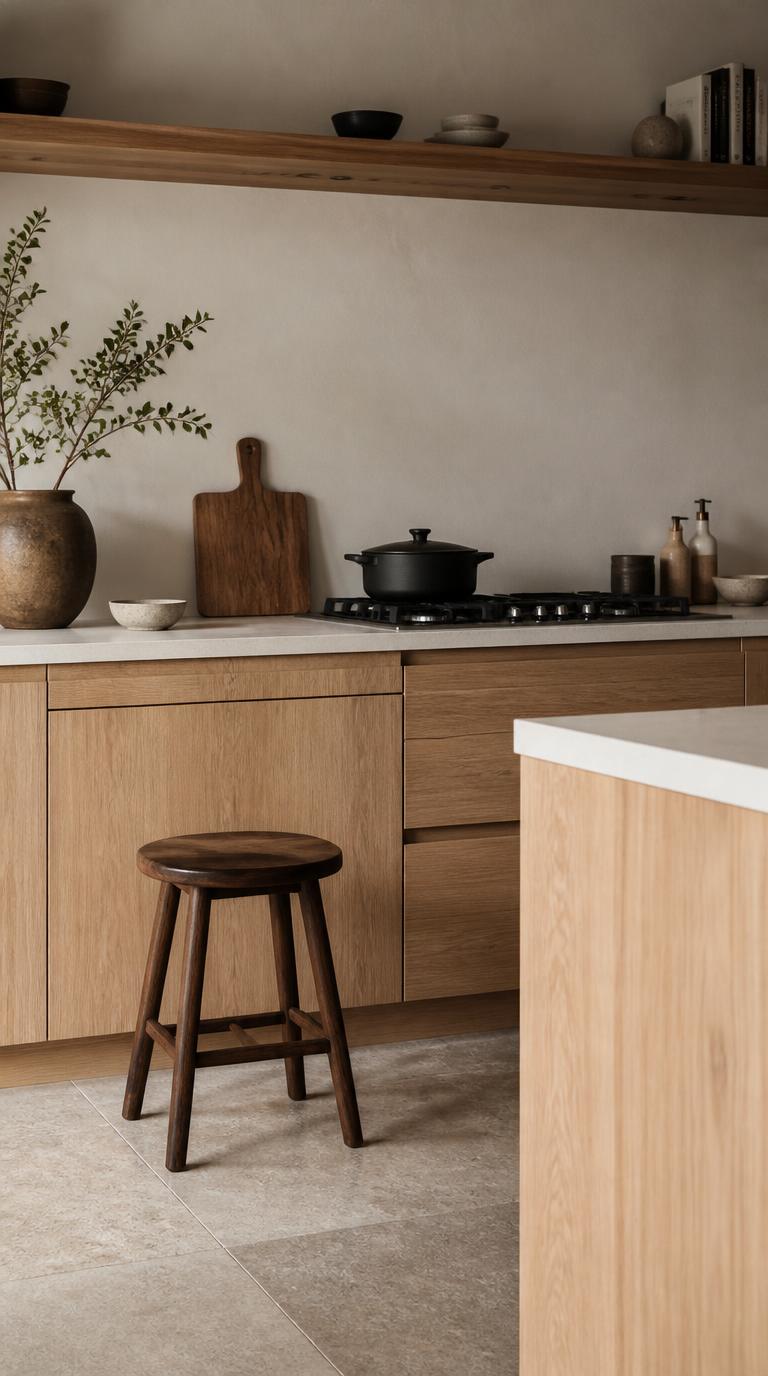
Two wood tones are plenty: one light, like oak or ash, and one deeper, like walnut, in small doses. Put the deeper tone on a stool, a shelf, or a cutting board.
Keep the undertones (the subtle warm or cool tint underneath a color) in the same warm family so the woods look related, not random.
Hardware and Faucet: Where I Save
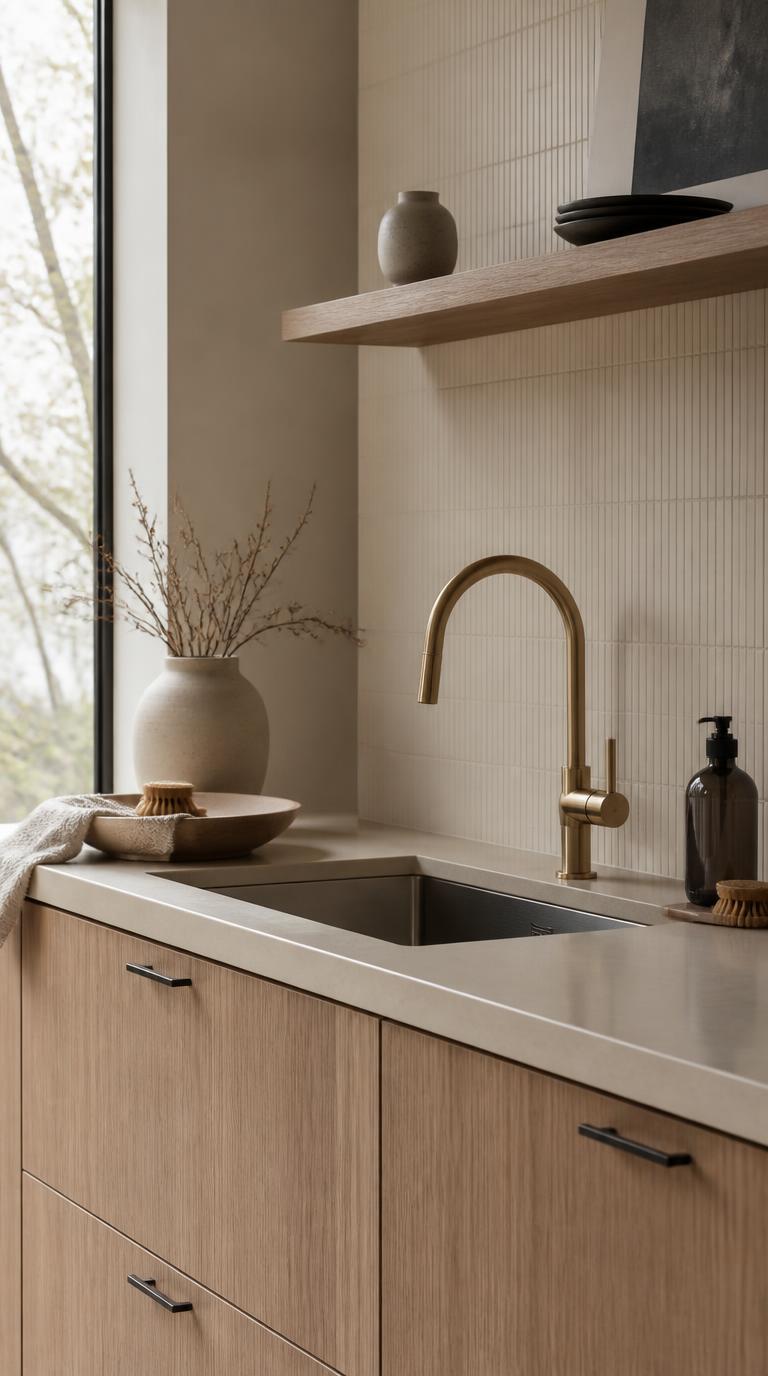
Here’s a real one from my own kitchen. I picked my kitchen faucet for its style, and I went with a budget-friendly one. It may not last as long as a pricier model, and I’m fine with that. I chose it for the look.
If you go budget on a faucet, look for a solid brass body, a ceramic cartridge (the inner valve that controls the water and resists drips), lead-free certification, and a written warranty. Those four things tell you more than the price tag.
Swapping it later is a DIY job or a one-hour plumber visit, and in an older home, check that the shut-off valves turn first.
For lead-free, look for NSF/ANSI 61 or 372 on the box.
Here’s the rule I follow: spend on what’s hard to redo and on the one piece people see first, and save on what’s easy to swap.
| Item | Splurge or save? | Why |
|---|---|---|
| Cabinet doors and boxes | Splurge | You live with them daily and they’re hard to redo |
| Countertops | Splurge | They take the most wear and set the whole tone |
| Lighting | Splurge a little | One good pendant lifts the whole room; save on the rest |
| Faucet | Save | Easy to swap later |
| Pulls and knobs | Save | Cheap to replace; measure the screw-hole spacing first |
| Canisters and ceramics | Save | Easy to add slowly, even secondhand |

My Top Tip: Choose your faucet for looks, not a long feature list. I bought mine on looks and price, and I’m happy with that trade. Just check how many holes your sink has before you click buy.
Warm Neutral Color Palette for a Japandi Kitchen
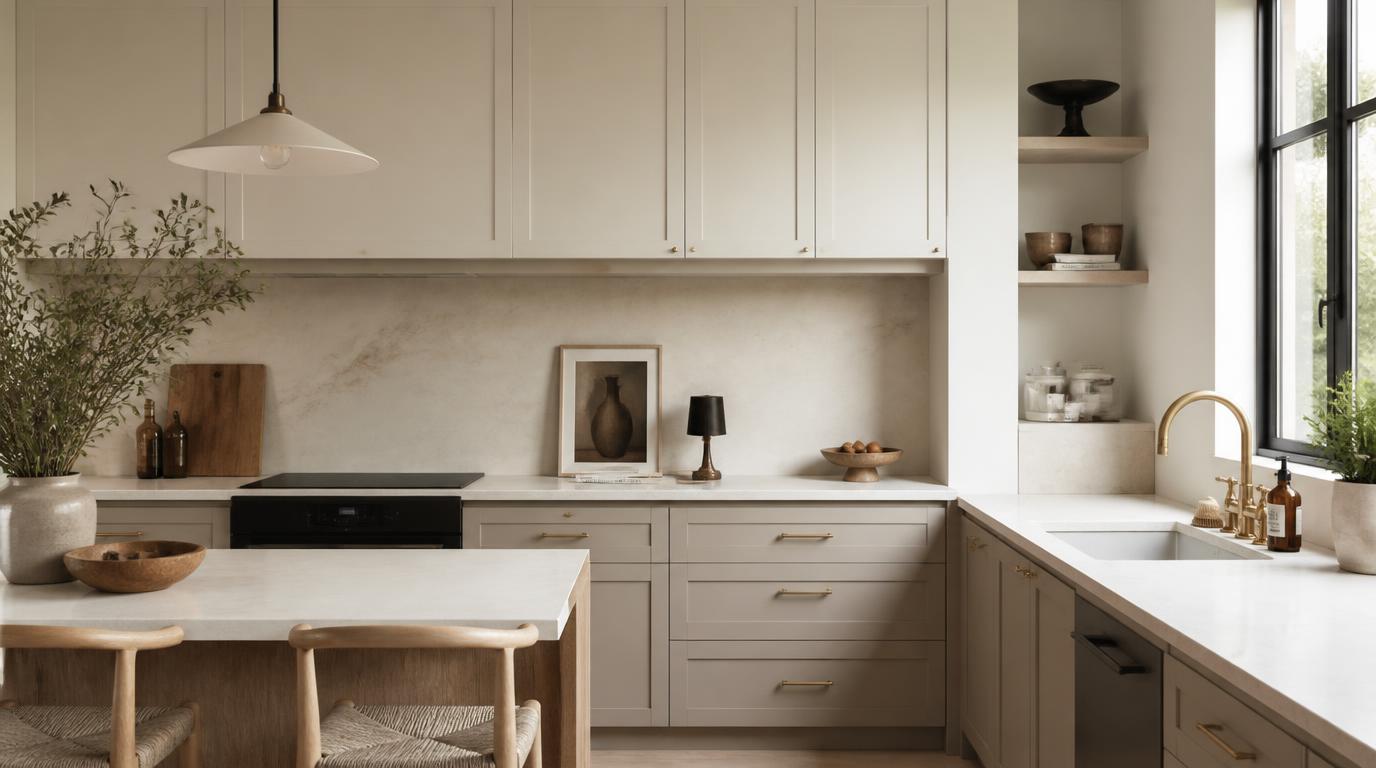
Warm neutrals, meaning creamy whites, sand, and soft greige, keep a Japandi kitchen bright without the chill of stark white.
Start With Three Colors


Think of your palette as a base, a middle tone, and a small dark accent. Paint names are just starting points, so hold a sample next to your cabinets before you commit. Here’s a simple recipe to borrow:
| Role | Color idea | Where to use it |
|---|---|---|
| Base | Warm white like Sherwin-Williams Alabaster or Benjamin Moore White Dove | Walls and upper cabinets |
| Middle | Soft greige (a warm gray-beige) like Sherwin-Williams Accessible Beige | Lower cabinets (if painted) or an accent wall |
| Accent | Charcoal or deep brown | Faucet, pulls, stool legs, one light fixture |
Want more warm neutral inspiration? My post on warm neutral kitchen hues goes deeper on what’s working right now.
Not sure if a white leans warm or cool? Hold a sheet of plain white paper next to your sample. The paper makes the undertone easy to see, whether it’s creamy, pink, or gray.
Add One Dark Accent


The Japanese side of Japandi loves a deep tone, and a little goes a long way. A matte black or dark bronze faucet, or a charcoal pendant, grounds the light colors. Brushed nickel or stainless works too. Pick two or three of these spots, then stop.
Test Paint in Real Light
Light changes everything. Check your samples in the morning, at noon, and after dinner.
Then pick warm bulbs, around 2700K to 3000K (the K is color temperature, and lower numbers glow warmer), so you see how the color will really look at home. 2700K gives a cozy golden glow, 3000K is a crisper warm white, and cool bulbs make creamy paint look harsh.
Check your sample under the exact bulb you’ll use.
My Top Tip: Paint a big sample board, about 2 by 2 feet on foam board, and tape it up next to your cabinets for a full day. Colors can swing from creamy to yellow as the light changes, and a board is cheaper to redo than a wall.
Japandi Kitchen Storage Ideas and Islands
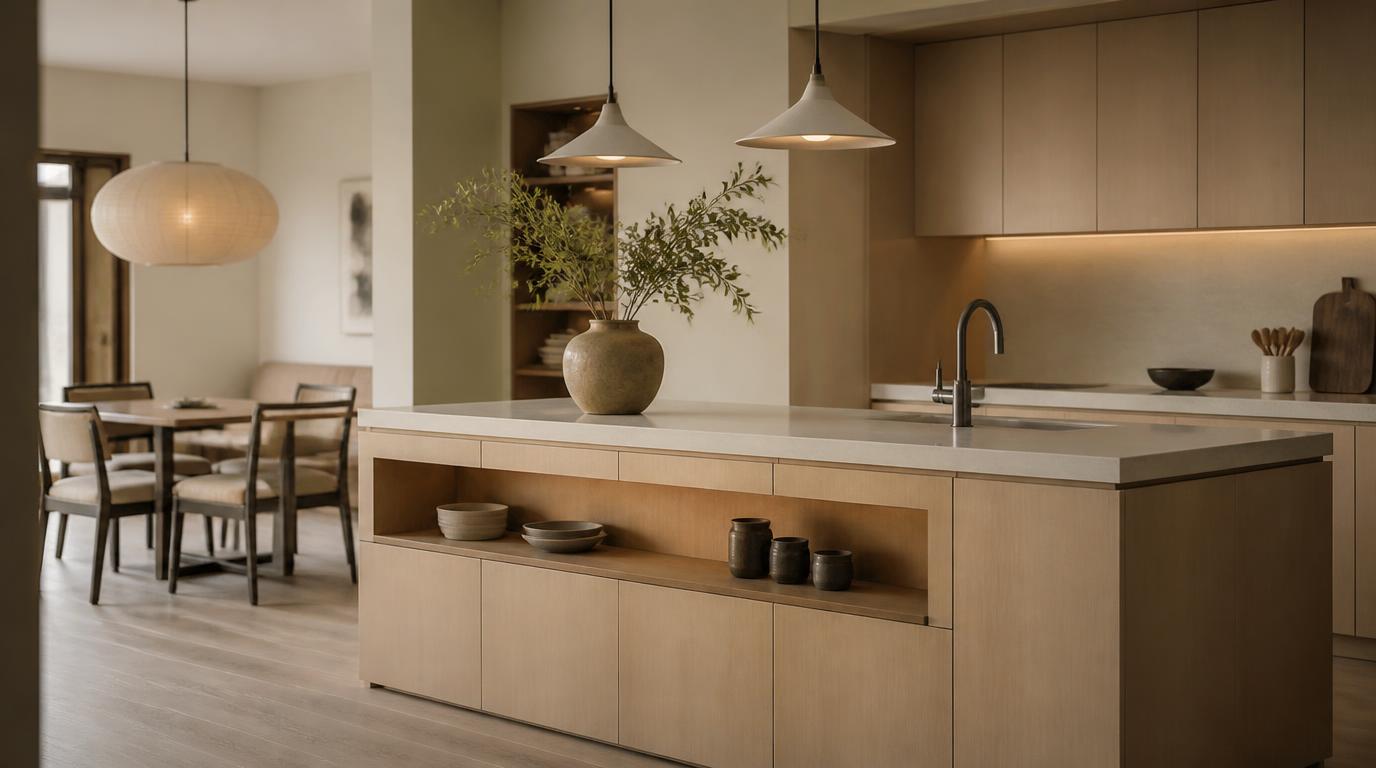
Hide the everyday stuff in deep drawers and keep just one open-shelf wall, and your counters stay clear.
Hide the Everyday
In a Japandi kitchen, deep drawers beat lower shelves for pots and pans, because you can see everything at a glance. Add a pull-out for oils and spices.
Tuck small appliances into one cabinet or an appliance garage (a cabinet with a door that hides your toaster and coffee maker).
Ask an electrician to add an outlet inside, or pick a cabinet that already has one, and pull toasters and coffee makers forward before you use them so heat and steam don’t build up.
One Open Shelf Wall, Not Five
Open shelving looks lovely when it’s styled, and messy when it isn’t. Give it one wall, two or three shelves at most, and keep it to a few ceramics and a cutting board in matching tones.
Japandi Kitchen Island Ideas
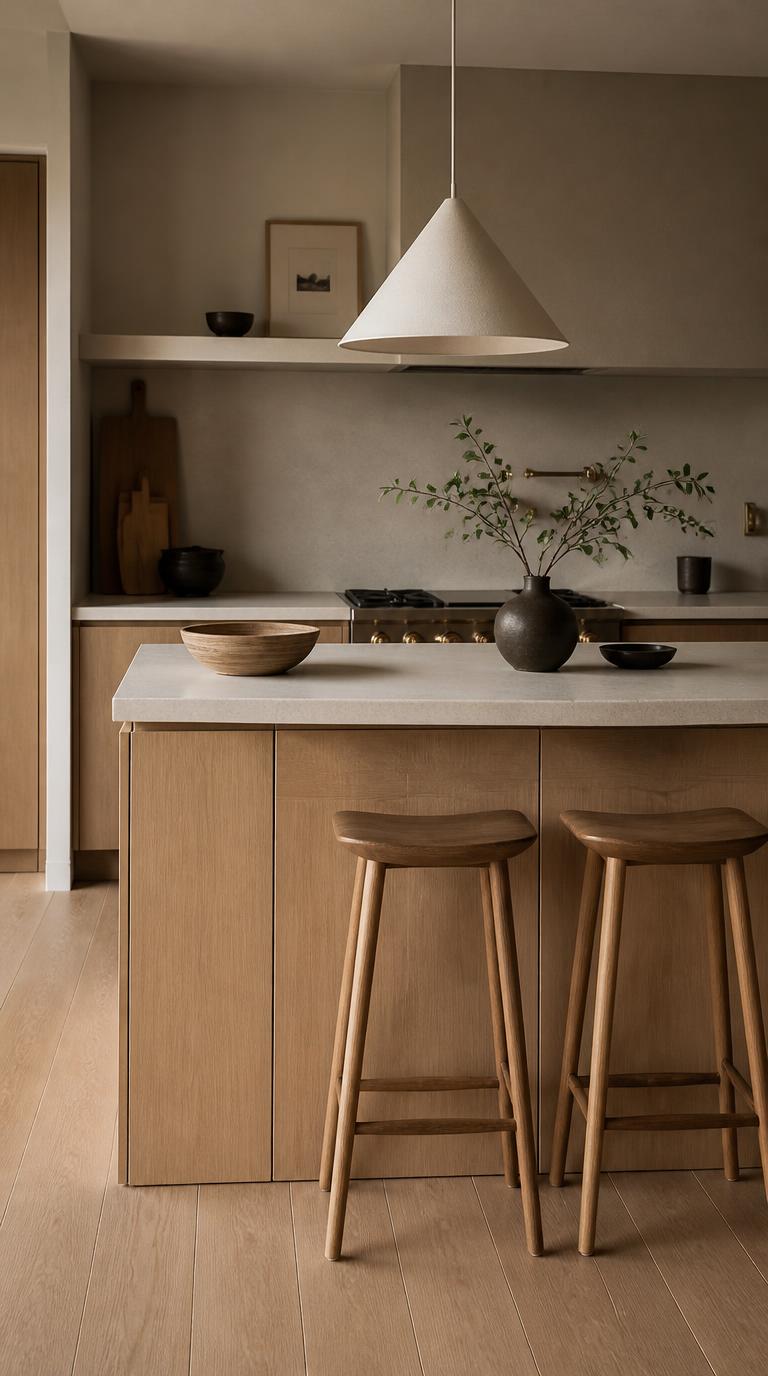
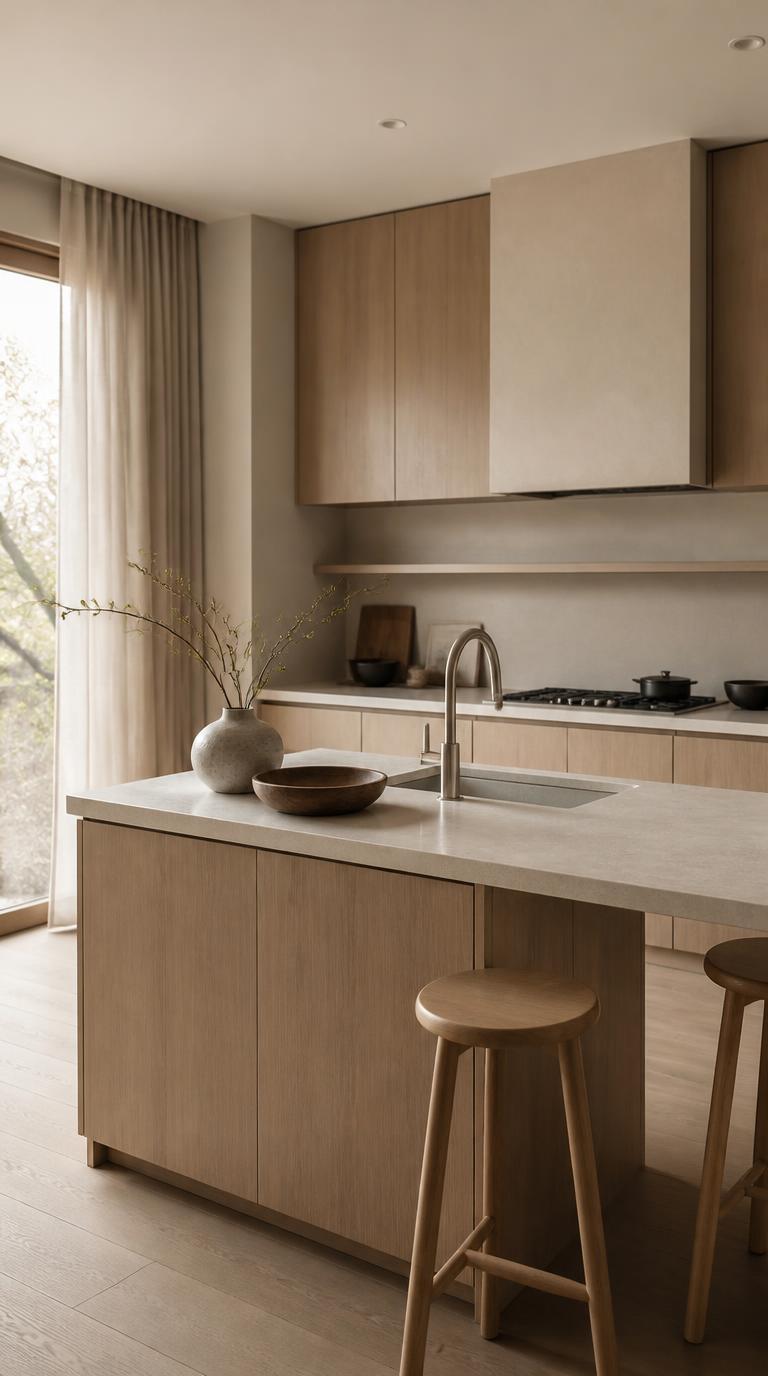
Keep the island simple, with clean lines and storage built in on the cooking side, not under the seating overhang. Leave at least 42 inches of clearance around it, and 48 inches if two people cook at once.
Add slim wood stools that slide under the counter. Counter stools usually have a seat height of about 24 to 26 inches, and you’ll want about 15 inches of counter overhang for knee room at counter height (bar-height counters need about 12).
Hang pendants about 30 to 36 inches above the surface so they light the space without blocking your view. If you use more than one, space them about 30 inches center to center, and raise them a few inches if your ceilings are over 8 feet.
Lighting for a Japandi Kitchen
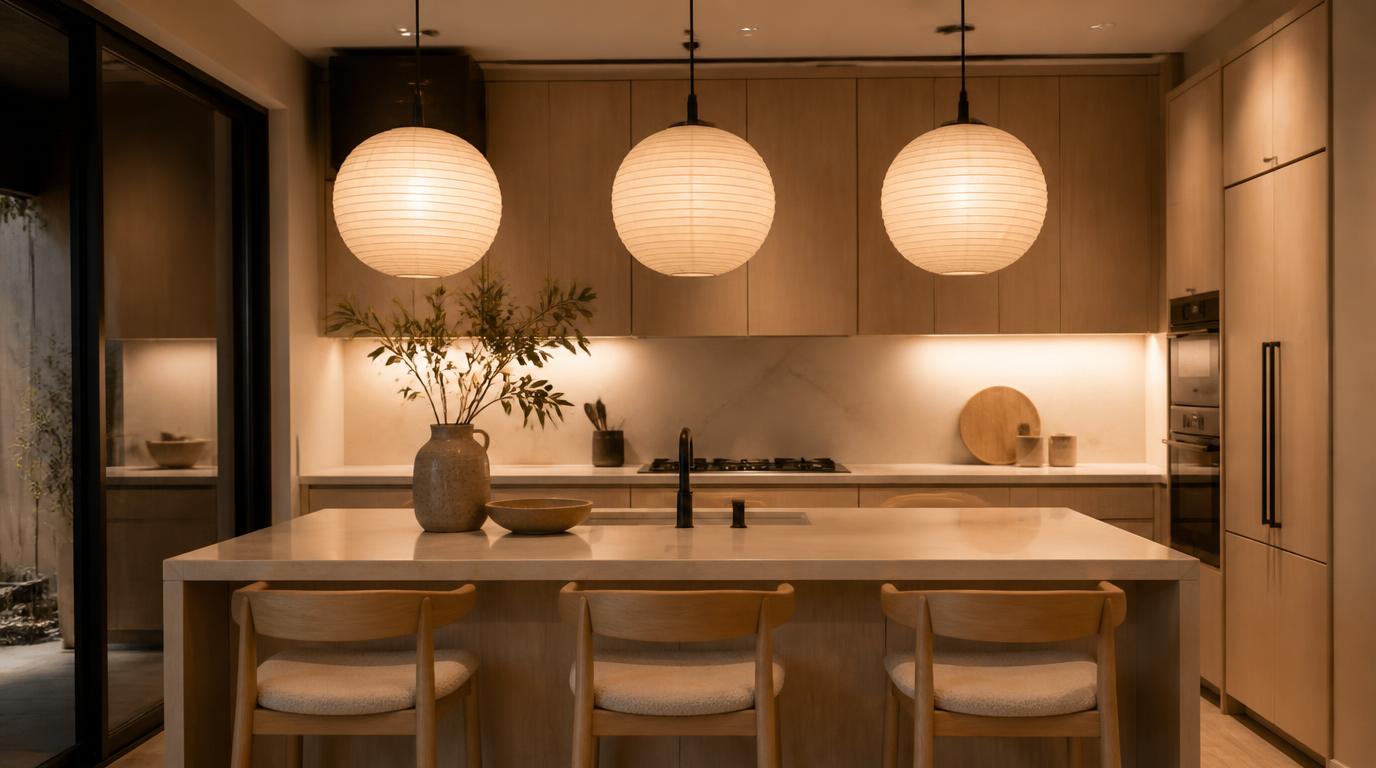
Use three kinds of light (overall, task, and mood) plus a dimmer, and your kitchen works for both cooking and late-night tea.
Ambient, Task, and Accent
Ambient light fills the room, task light shines where you chop, and accent light adds mood. A layered approach might mean recessed lights overhead, strips under the cabinets, and one or two pendants over the island.
Paper and Wood Pendants
Paper lantern shapes and wood details echo traditional Japanese lighting and soften a hard-edged room. They scatter light gently, so they’re lovely over a table or island.
Keep paper shades a few feet from the cooktop, where heat and grease will mark them, and use cool-running LED bulbs made for enclosed fixtures inside them, within the fixture’s bulb rating.
Dimmers Are Worth It
Put your Japandi kitchen’s main lights on a dimmer. Bright for cooking, low for late-night tea. Use dimmable LED bulbs with a compatible LED dimmer, or they may flicker. If you swap a switch for a dimmer yourself, turn the breaker off first, or hire an electrician.
For under-cabinet strips, look for a high color rendering score (CRI, or color rendering index, of 90 or higher) so food and wood look true. Plug-in strips work well for renters, while hardwired ones usually call for an electrician, depending on local code.
Appliances and Everyday Upgrades
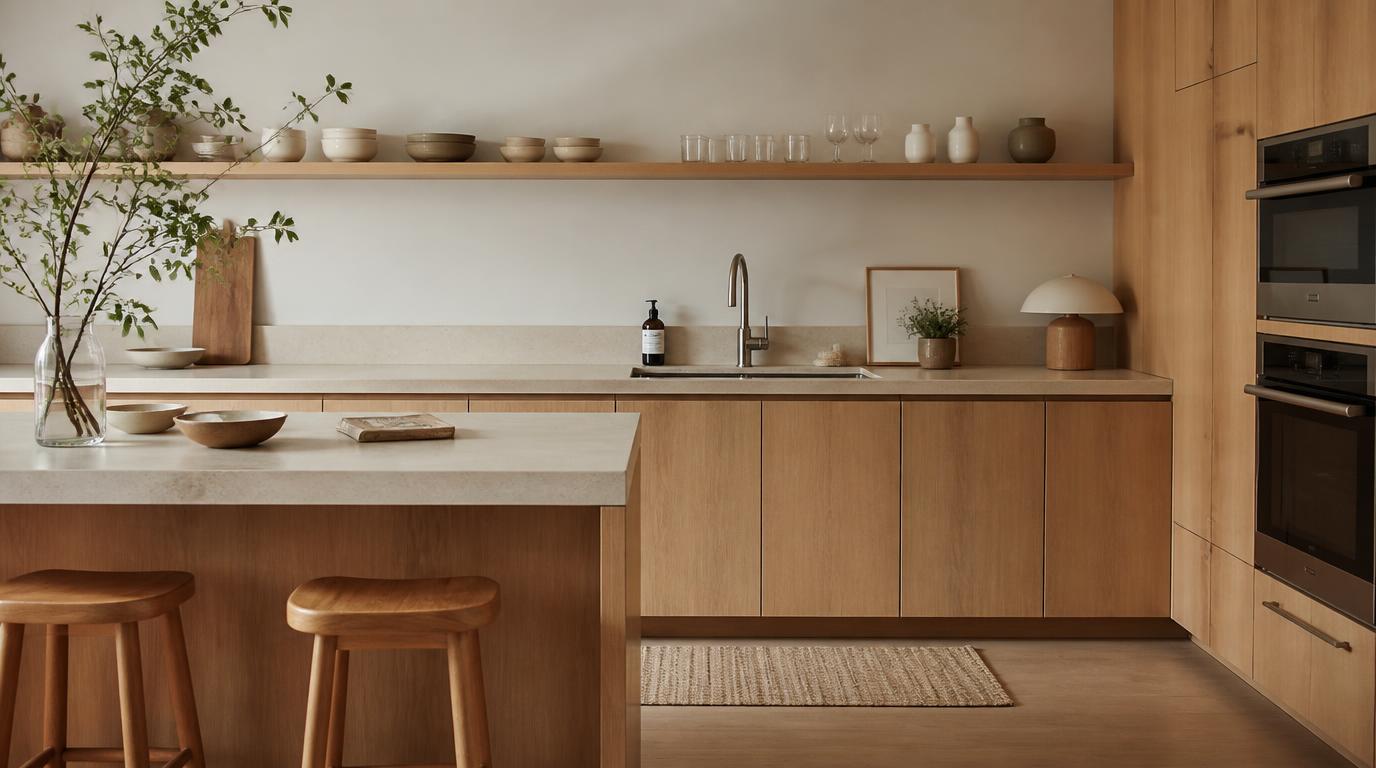
Hide the appliances behind panel doors, then spend the upgrade money on what you touch every day, like a water filter.
Panel-Ready and Built-In Appliances
Panel-ready dishwashers and fridges (built to take a matching cabinet front) wear the same doors as your cabinets, so they disappear.
On a tighter budget, choose matte stainless or white. Only enclose a microwave that’s rated for built-in use, and leave the ventilation space its manual calls for.
The Upgrade I Recommend Most: A Water Filter
I bought a water filter on Amazon and installed it myself. It turned out to be ridiculously handy, and I can’t recommend it enough.
Honestly, it’s the upgrade I’d recommend most for everyday life. It also fits the Japandi way, since clear water on demand means no pitcher to refill.
Look for a filter certified to NSF/ANSI 42 or 53. Standard 42 covers taste and odor, like chlorine, and standard 53 covers health-related contaminants such as lead.
Certification applies to specific models, so check the exact model you’re buying. And make sure the type, faucet-mounted or under-sink, fits your sink setup before you order. When you install it, follow the maker’s instructions and shut off the water first.
My Top Tip: Put a reminder in your phone for your filter’s replacement date, because a cartridge past its life won’t do its job. If you choose a faucet-mounted filter, pick a finish that matches so the counter stays tidy.
Small Japandi Kitchen Ideas
A small Japandi kitchen works because the style already loves less, so you only need to be a little stricter.
Keep the Palette Tight
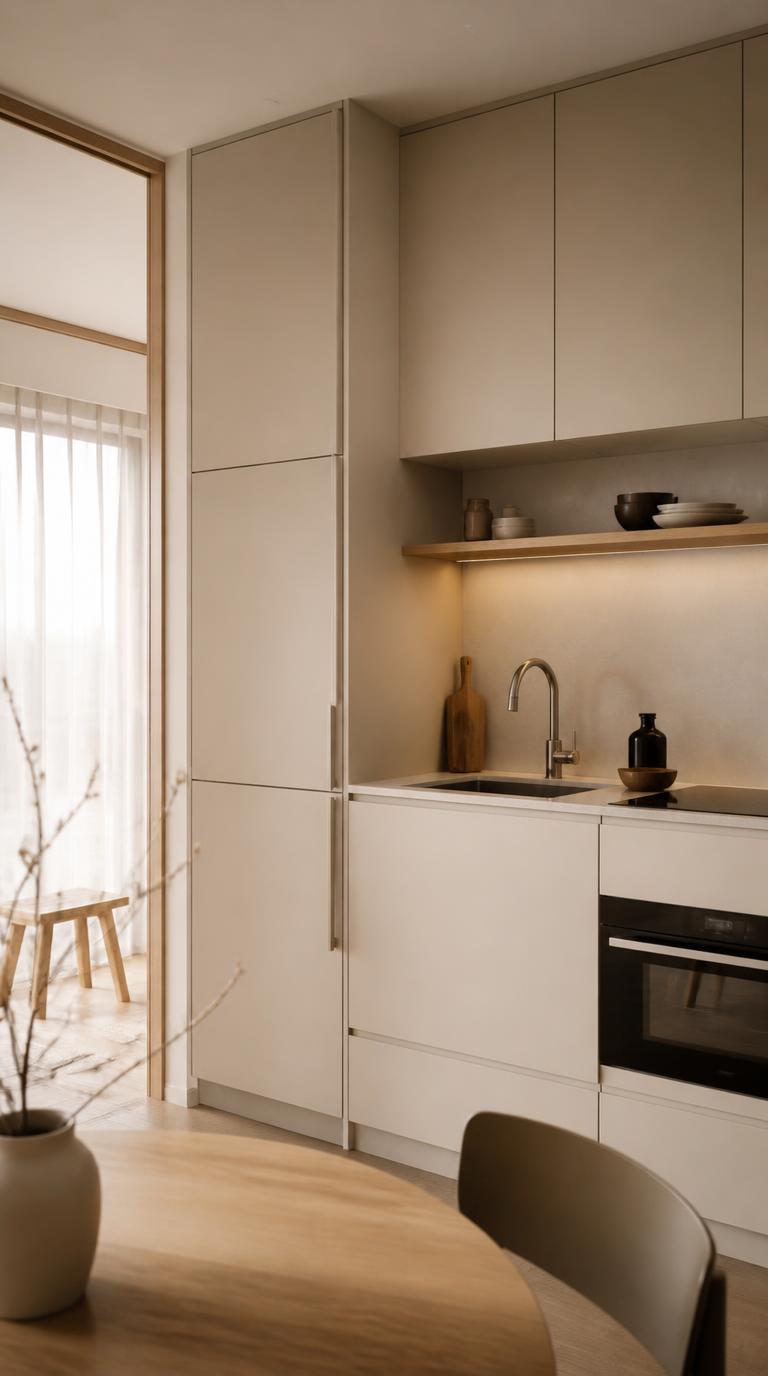
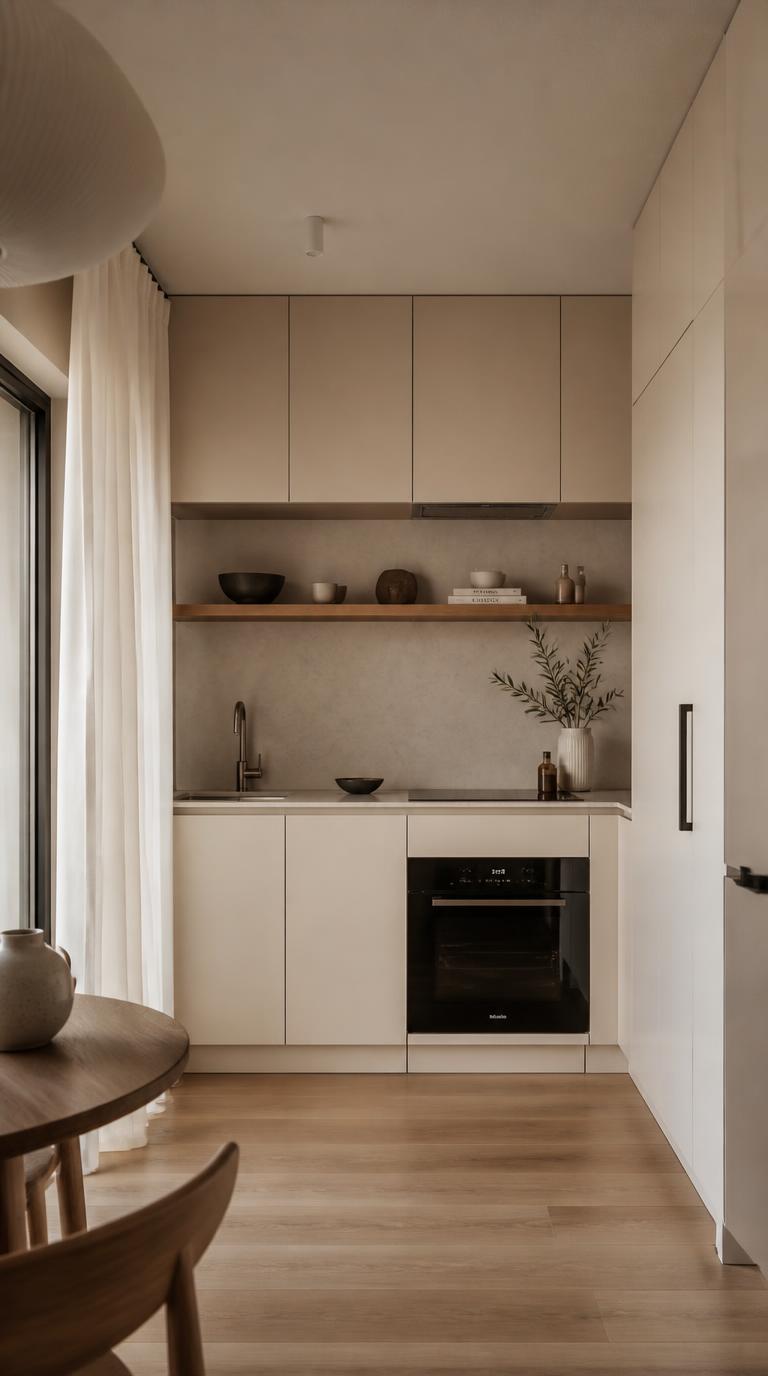
In a small Japandi kitchen, use one wood tone and one warm white, then repeat them. Fewer colors make a small room feel bigger and calmer.
Go Vertical
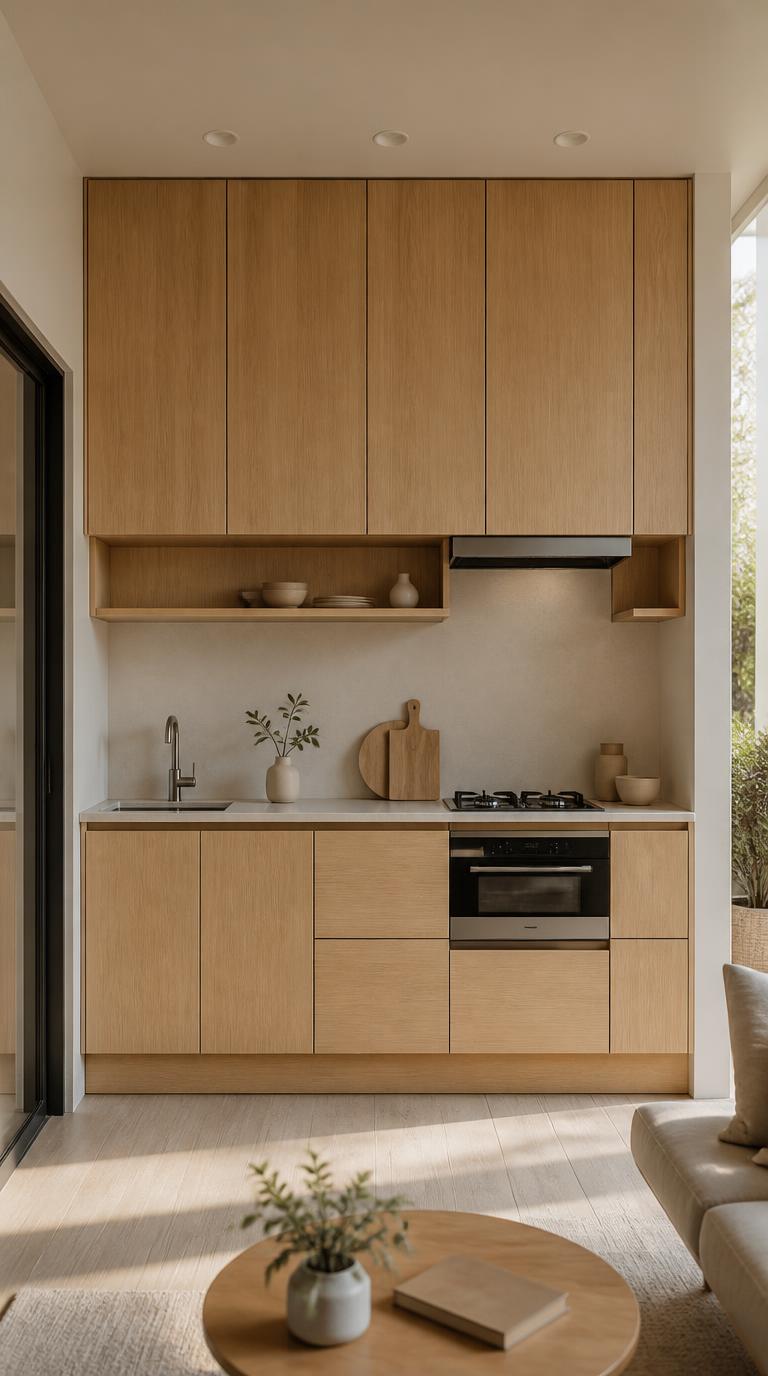
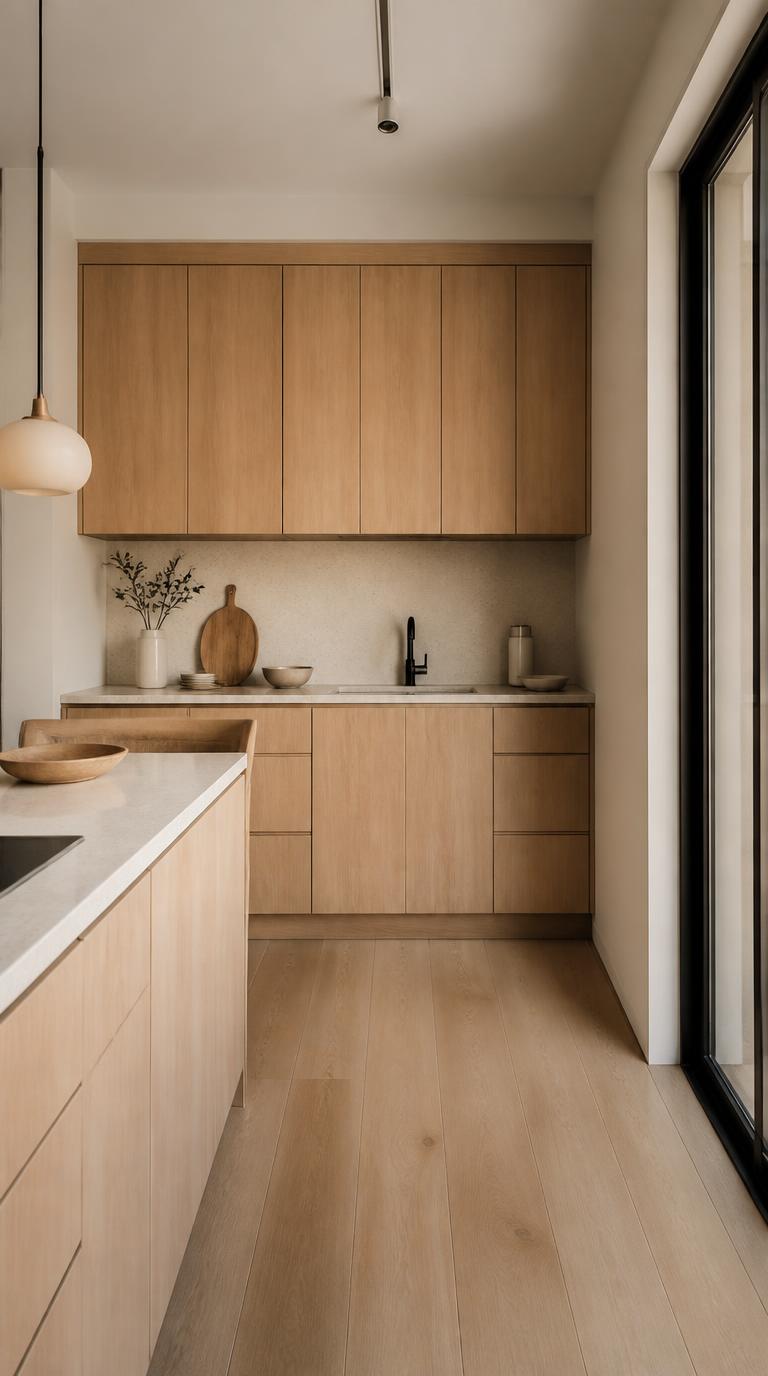
Take cabinets up toward the ceiling and add under-cabinet lighting to keep counters free. Use the tall spaces for things you rarely need, and keep daily items at arm’s reach.
Skip the Island if Space Is Tight
If your aisles would drop under 42 inches, skip the island in a small Japandi kitchen or use a slim rolling cart instead. Aim for 42 inches where you cook. A plain walkway can squeeze to 36, but that’s the absolute floor.
Let One Thing Shine
Pick one star, like a paper pendant or a handmade bowl, and let everything else stay quiet. One focal point is enough.
Common Japandi Kitchen Mistakes to Avoid
Most Japandi kitchen mistakes come from copying the look without the function.
Watch for these six, and you’ll save yourself a redo:
- Going stark and cold: Pure bright white feels clinical, so choose warm whites.
- Too many open shelves: More than one wall of shelving turns into visual noise.
- Mixing too many woods: Stick to two tones, one light and one deeper.
- Busy tile patterns: Let simple shapes carry the wall.
- Skipping function for looks: Plan drawers and zones before you pick finishes.
- Harsh bulbs: Cool, bright light flattens warm neutrals.
Fix those, and your space will feel calm and ready for real life.
Where to Start: Your One-Weekend Japandi Kitchen Refresh

You can give your Japandi kitchen a calm refresh in one weekend with five small steps and no renovation.
Before the weekend, pick up warm 2700K bulbs, a sample-size pot of warm white paint, and a sheet of foam board. Pulls are optional, only if you do the last step. The most important steps are Friday night and the sample board, and the rest is bonus.
Then try this simple order of operations:
- Friday night: Clear the counters down to three everyday items, and swap in the warm bulbs (check the bulb base and dimmer type first). If you want new pulls, measure center to center and order matching ones now.
- Saturday morning: Paint a 2 by 2 foot sample of warm white on foam board, which stays flatter than poster board if you use thin coats. Add the second coat after the first dries, about 2 hours or as the can says, then tape it up. It needs a full day to show its true color.
- Saturday afternoon: Edit your open shelf to a few pieces in matching tones, or clear one counter zone if you have no open shelf.
- Sunday morning: Look at your sample in daylight, and again tonight under your new bulbs.
- Sunday afternoon (optional): Unscrew the old pulls and screw in the new ones in a simple matte finish.
That’s a real Japandi refresh in a weekend, and none of it needs a contractor.
My Favorite Shops
Discover curated modern furniture from these premier online shops!
My Handpicked Selections
If you want one splurge from this list, make it the Soft Paper Pendant Light. A warm pendant changes the whole mood of the room.
Joss & Main: a good stop for warm, natural pieces that feel real. Their Cira Acacia Solid Wood Cutting Board is a smart pick. It’s listed as solid acacia, so it can work as a serving board. A board you use daily counts as one of your three counter items.
I’d also grab the 3 Piece Kitchen Canister Set for the pantry shelf or a cabinet. If one earns counter space, swap it for one of your three.
2Modern: a great place to browse for Japandi lighting and decor. The Soft Paper Pendant Light from Case Furniture stands out, with a rice paper shade, a wooden ring, and a soft, diffused glow. It starts at $180 at the time of writing.
If you want one wabi-sabi piece, the Kumi Stoneware Teapot looks handmade and earns its spot if you use it for daily tea.
If the pendant is more than you want to spend today, the cutting board and canisters above tend to cost less than a pendant, so check current prices. They bring in that same warm, natural feel.
AllModern: simple, modern seating without the fuss. The Fitz 24″ Counter Stool (Set of 2) is listed with slim, tapered legs in solid rubberwood, which is the simple wood look a Japandi island wants.
The Corrigan Studio Jute Bar and Counter Stool adds a natural, woven texture in counter or bar height. Jute can soak up spills, so it suits a low-mess kitchen best.
FAQ
Warm neutrals, light wood, hidden storage, and layered light cover most of what people ask about Japandi kitchen design, so here are the quick answers.
What is Japandi kitchen design?
Japandi kitchen design blends Japanese minimalism with Scandinavian warmth. Expect clean lines, natural wood, warm neutral colors, and hidden storage that keeps counters clear.
What colors work best in a Japandi kitchen?
Warm neutrals like creamy white, sand, and soft greige work best, with one deep accent such as charcoal or dark brown. Avoid stark white and cool gray, which can feel cold.
What are Japandi kitchen cabinets?
They’re flat-panel cabinets in light wood or warm white with a low-sheen finish, plus slim pulls or no handles. The goal is quiet lines that let the materials stand out.
How do I make a small kitchen a Japandi style kitchen?
Keep the palette tight, use one wood tone, take storage up toward the ceiling, and pick one focal point, like a paper pendant or a handmade bowl.
What lighting suits a Japandi kitchen?
Layer ambient, task, and accent lighting with warm bulbs around 2700K to 3000K. Paper or wood pendants and a dimmer give the softest result.
What materials are common in a Japandi kitchen?
Light wood like oak or ash, honed stone or quartz, and ceramic are the classic trio. Bamboo, rattan, and linen can add soft texture.
Can I do a Japandi kitchen on a budget?
Yes. Spend on cabinets and counters, and save on faucets and pulls. Repainting cabinets in warm white enamel is another lower-cost move. Test for lead first if your home predates 1978.
How do I repaint kitchen cabinets?
If your home predates 1978, test for lead first. Remove the doors and hardware, degrease, and scuff-sand lightly. Prime with a bonding primer, then paint two thin coats of cabinet enamel. Go easy on the doors for about a week, since enamel keeps hardening for weeks.
Do I need to test for lead paint before sanding?
If your home was built before 1978, yes. Use an EPA-recognized test kit or a certified pro before you sand or scrape anything, and don’t sand it yourself if it tests positive.
Is Japandi the same as Scandinavian style?
Not quite. Scandinavian leans brighter and more pastel. Japandi keeps that warmth and adds Japanese calm, a deeper accent color, and fewer objects on display.
Is a Japandi kitchen practical with kids?
Very much. Flat-panel cabinets in a low-sheen finish show fewer fingerprints, deep drawers keep daily items within reach, and a clear counter makes wiping down faster. Pick quartz over soft stone for easier care.
How much does a Japandi kitchen refresh cost?
The weekend plan is mostly bulbs, pulls, and a paint sample, which are the cheapest place to start. Cabinets and counters are the big line items, so price those last and get a couple of local quotes first.
Can I get a Japandi kitchen in a rental?
Absolutely. Swap the bulbs and pulls (keep the originals to put back), add a plug-in pendant or under-cabinet strip, and style the counter with one wood board and a few ceramics.
Is a Japandi kitchen still in style?
According to Pinterest Trends, searches for Japandi kitchens have stayed steady over the past year, and the look is calm and practical rather than tied to one season.
Can I have a Japandi kitchen with white cabinets?
Totally, as long as the white is warm rather than stark. Add light wood, a little texture, and one dark accent, and white cabinets work beautifully.
Is a Japandi style kitchen too plain or cold?
Not if you keep it warm. Wood, handmade ceramics, soft textures, and warm 2700K to 3000K bulbs keep it inviting.
What is the difference between Japandi and minimalist?
Minimalist strips a room down. Japandi keeps the calm but adds warm natural materials and a few handmade pieces.
The Bottom Line
A Japandi kitchen comes down to a few warm, natural materials, a clear counter, and layered light, not more stuff. Give each thing a place, and let the room breathe.
Start tonight with the free one: clear your counters down to three things. Your easiest first buy is warm 2700K bulbs, and your one splurge from the shopping list is the paper pendant. One change at a time adds up fast.
I’d love to see how you style yours! Share your photos and tag me on Instagram or Pinterest, because it truly makes my day to see your beautiful spaces come to life.



ABOUT the AUTHOR
TOKI; INTERIOR DESIGN & lifestyle CONTENT CREATOR.
Hey there! I’m Toki—the design-obsessed brain behind Dwell Studio 24. I’m a content creator passionate about interior design, photography, and creativity, living in a 77-year-old house with my husband and our awesome three kids. I write about interior design, furniture, home topics, and my lifestyle, including travel, recipes, skincare, and daily routines. I hope to inspire your next project and lifestyle!
ABOUT the AUTHOR
TOKI; INTERIOR DESIGN & lifestyle CONTENT CREATOR.
Hey there! I’m Toki—the design-obsessed brain behind Dwell Studio 24. I write about interior design, furniture, home topics, and my lifestyle, including travel, recipes, skincare, and daily routines. I hope to inspire your next project and lifestyle!